Showing posts with label Art Galleries. Show all posts

Sunday, 26 February 2017

Let's Find Fred Blog Tour and Giveaway - Inspiration and the Creative Process

Today we are lucky to be joined on the blog by author and illustrator Steven Lenton who has written a guest post for us to celebrate the publication of his new picture book Let's Find Fred. With its brilliantly captured detail, bold colours and humorous cameos, this book is a pleasure for children and adult alike and the girls have been enjoying it on bedtime-story repeat for the last couple of weeks - not least due to the movable panda eyes on the front cover.

For any art-lover, the book is worth buying simply for the double page spread where naughty Fred, chased by his exhausted zoo-keeper, escapes through a gallery filled with cleverly panda-ized art and artefacts... from Egyptian panda deities and Warholed versions to Mona-Bear and the Bear with a Pearl Earring. If you look closely through the story, you can also spot the Beatles and other cultural cameos.

For his guest blog post, we asked Steven to tell us about where the inspiration came from for his book, and how the creative process works. He's also treated us to a glimpse of some of his early sketches and concept designs. I love looking at these images - they are an unparalleled chance to see where picture book illustrations begin, and give us a glimpse of the hand of the creator behind the polished result we only usually get to see.

"Let’s Find Fred was created from an original concept by Scholastic and my fun animal character designs that they spotted in both my earlier picture books and greeting card designs.

Over the years I have loved visiting zoos and have drawn lots and lots of animals in both my sketchbooks and final artwork for picture books. I love drawing and designing animals so when Scholastic approached me with this project I leapt at it like Fred at a Candy Floss factory!
Creating the aesthetic for Fred was a very collaborative process and I really enjoyed designing a new Panda character.

Here are some early concept designs:

I always start my books with lots of pencil sketches of the main character, then any subsidiary characters, in this case Stanley the Zoo keeper and the other animals.


The large, round fluffiness of Fred works nicely with Stanley who is very angular and sharp – inspired by the Mr Man, Mr Rush – his triangular nose always pointing in the way of the chase!


Once I have designed the characters in my sketchbook in black and white (VERY handy for a Panda!) I then move on to colour – in this case I thought it would be great to give Fred a red accessory and a tie seemed to be the perfect fit for Fred – I tried a regular tie but it made him look too much like a business panda and was a bit too serious, so a bow tie it was!

The Scholastic team and I wanted to create a fresh, bold look for Fred and I researched lots of ‘Spot the…’ genre of books to get an idea of the kind of styles that work well with this kind of book.  I decided on a colourful, minimal-lined style, not dissimilar to my usual work but with a simpler, less chalky edge.  This was mainly because, as there a lot of small details and characters among the varied city scenes, bold silhouettes, clear to read expressions and acting were essential. 
The background elements such as vehicles, signage and foliage were fairly simple to design once the characters had been set – bold, simple lines and colours with a varied palette on each spread to enhance the atmosphere and theme of each scene.
 The final look and feel is hopefully a nice combination of contemporary design and a warm, cuddly, fun collection of characters, vehicles, environments and narrative.  I hope everyone enjoys the book – it really was such fun to create!"
I love the sort of story book adventure that re-imagines famous art through the eyes of other creatures. It gets you to really look at why certain works are so recognisable, even when adapted, and it is always a joy to see how the unique styles of artists have been so effectively captured as part of other worlds. Two others I'd recommend are ones I collected a while ago and they are both great introductions to art as well as lovely stories. The first is part of the well-known suite of original Babar books. Here the royal family of elephants turn to philanthropy and create a museum to house all the work they have collected over the years - modelled on a combination of the Musee D'Orsay and the Met in New York, and containing much of the canon of famous works (plus an artist in residence - Pollock!). The family move through the museum discussing what they like and why - its a great exploration of what museums and art are really for and how they can serve as inspiration for our own creativity. The second is a sweet tale about a group of cats who are unimpressed that little of the art they see contains images of felines. They set out on a journey round the globe to rectify the situation. Of course the Mona Lisa needs a cat to cuddle, Van Gogh's chair is far too empty and there are always cats in homes. Where is Las Meninas' cat?  This pair of books are a great addition to any little Culturebaby's bookcase.

a Rafflecopter giveaway

Friday, 6 January 2017

Victorious Victoria and Albert


We've just returned from one of those sorts of afternoons that reminds me why I never want to move far from London, or its mind-blowingly brilliant museums. Yet again, it is time spent in a museum that might not always be a first choice for parents, that has yielded one of the most inspiring days for our young rabble. The Victoria and Albert was crowned Museum of the Year in 2016 and rightly so. It is a treasure trove of interesting, exquisite and unexpected things; a rabbit warren plunging straight into Wonderland. It's one of our favourite spaces and on every occasion we discover something new. I've written about it before, years ago, when we first discovered London's best kept secret toddler sunny day playground in the form of its courtyard. With a shallow central pool, which children are welcome to paddle in, lawns and a little cafe, it is a haven from the bustle of London and harbours rather an appropriate fin de siecle air of jolity and festival. We've also covered its great little educational backpacks in a post about animals in art (here).

Today's more wintery visit was rather unplanned. We showed up with a vague list of things the children wished to see, but we were rewarded with a Christmas-themed trail which took us on a tour to discover 12 objects and facts about Christmas around the museum. The beauty of this simple and hugely effective activity was that it directed us away from our normal well-trodden routes to look at items nestled within a huge range of collections. Starting from the central Christmas tree, we were signposted through the stunning Renaissance Galleries via an unusual Naplese crib, to the exquisite glass galleries  where we learned about the genesis of Christmas baubles (apparently once strings of small glass beads draped on German trees). We were then led past Trajan's column (much to the delight of Clara Button fans) and through to a display of Victorian Christmas cards. We learned that the first Christmas card was sent by the then - far too busy to write a traditional letter - Director of the V and A itself; an idea that in time caught on. We discovered mistletoe-themed Art Nouveau jewellery, St Nicholas hiding amongst a collection of biscuit tins and the partridge from the pear tree in silverware.

In the brilliant theatre galleries amongst the costumes and sets, we learned about the origin of crackers and that pantomimes come from ancient Rome when festivities allowed roles to be reversed and hierarchies subverted. Finally, we toured the picture galleries, where we were tasked with finding a family of carolers, located a Christmas dining set in the vast ceramics study collections and ended at a Christmas tree somewhere in the Tudor period.

We emerged with a better spatial awareness of the museum's vast corridors and new favourite areas for a return visit. We were also rewarded with a wonderful festive surprise - a performance of The Nutcracker for families. Abridged and danced by a young troupe from Highgate, supported by adult Nutcracker and Sugarplum Fairy, we were treated to a refreshingly interactive and intimate performance. Children were invited to dress the tree at Clara's party, dance with the ballerinas and meet the cast. It was an entirely joyful and bewitching experience for all involved.

The V and A is one of those museums where a small item can lead to huge inspiration, or you can focus on an era, a theme or follow a simple story around the vast collections. We've also read our way around the museum and gathered a range of books to bring the objects alive. Here's a selection of picture books to accompany a visit to the V&A - from costumes, tutus and home decoration to ceramics and 20th Century design.


First up; an interactive fashion guide so beautiful we wrapped it up for Culturebaby's recent birthday. Using photographs and archival information from the V&A's own collections, accompanied by illustrations by Daisy de Villeneuve, Fashion Mash Up contains timelines detailing the development of items from skirts and trousers to shoes and coats. It contains 75 press out clothes to add to a selection of stand-up models, backdrops for fashion shoots, stickers for accessorising, and a selection of unusual items for mix and matching and play.

Following the success of a jewellery history game using a £3 pack of V&A postcards (see here for how to create this activity), I'd intended to amass a dress version for the girls, who love this part of the collection. Happily this clever book does the job for me. The press-out garments can be lined up, examined and ordered. It's a brilliant addition to our history shelves.


Alongside this book I'd also recommend the simple but beautifully illustrated The Story of Costume by John Peacock.

Still on the topic of the fashion collections in the museum, there are few story books as exquisitely illustrated with details from a museum collection and as effective as the V&A's own Clara Button series by Amy de la Haye and Emily Sutton. We own Clara Button and the Wedding Day Surprise, which showcases a selection of bridal wear from the collection and extols the virtues of creativity and adaptation, and (the favourite) Clara Button and the Magical Hat Day. This gorgeous picture book usually comes with us on trips to the V&A, as it contains gorgeous illustrations of a range of spaces in the museum (including the exquisite cafe), as well as some iconic items for the children to spot. The story follows a creative little girl Clara who, on requesting a hat-themed day, is taken by her mother to the V&A. She takes with her a precious vintage hat (broken by her naughty brother) in the hopes that someone at the museum can help her fix it. She's rewarded by a behind-the-scenes hat extravaganza, and her brother (busy pretending the whole experience is tedious when in fact he's having a whale of a time) finds inspiration amongst the weapons and cast galleries - encountering the fabulous Tipu's Tiger and monumental Roman Trajan's Column.

Earlier in the year we received a thoroughly inspired fairy tale series, perfect for the little historian. With the best will in the world, multiple readings of fairy tales can border on the dull, but this brilliant little set from David Roberts and his sister Lynn Roberts-Maloney aims to re-invent classic tales in the style of various periods. Cinderella is retold in glorious Art Deco glamour with 30's costume, gramophones and Clarice Cliff pottery. Rapunzel is a '70s readhead, clad in platforms and bell-bottoms and imprisoned at the top of a brutalist tower-block with a collection of vinyls and a permanently broken lift.


Then there's the most recent (and cleverest) title: Sleeping Beauty: A mid-century fairy tale. Beginning in the 1930's at a Christening, and stretching to the 1950s for the 16th birthday, the illustrations are brimming with period detail. Protected from needles by her adoring aunts, Annabel dreams of seeing the future. Her wish unexpectedly comes true when she pricks her finger on the stylus of a record player - a gift from the evil Morwenna. Refreshingly the tale takes a twist and Sleeping Beauty is not rescued by a prince but by a girl 1000 years into the future named Zoe who has a passion from the past and scours the library for evidence of why a giant thorn-tree is found amidst a futuristic high-rise landscape. The aunts equally take on a delightful role as protectors who ultimately sacrifice themselves for their beloved ward. It's a great re-telling anyway, but the period details confirm this picture book offering as a 20th Century historical tour de force.


One more title worthy of mention for its stunning illustration and period details is Alice Melvin's beautiful Grandma's House from Tate Publishing. The inspiration for this simple story about a girl's search for her grandma throughout the old lady's beautiful house, was Alice's own childhood memories of such trips. A decade on from her Grandmother's death, the intricate details of items around this beloved destination show keen observation and great love. "Even now, over a decade since she died, I can close my eyes and retrace my steps with ease: moving from room to room, knowing exactly what I will see as I do so: the cow milk jug with the tiny bell around his neck; the little porcelain wren that lifted up to reveal three small bead eggs; the wooden apple with the tiny wooden tea set hidden inside; the garden path winding past the pear tree..." Both a tribute to a beloved family member and a great lens through which to view the objects before us in the museums cabinets, this simple books shows with ease the way in which each object is both imbued with a host of meanings and emotions and provides a new angle for us to search through the collections for items with a similar meaning for us too.

A lovely title I picked up in a charity shop recently is another great story about the decorative arts, and in this case one single object - a Delft Blue vase. Ingrid and Dieter Schubert's Delft Blue: a Vase for the Princess is from the Gemeente Museum in Den Haag. Lin, a Chinese mouse finds himself a stow-away on a shop bound for Holland - a country he finds utterly different from his home. He is befrended by a local mouse from the 'best potters in town' and introduced to Lin's tea ritual in a tiny Chinese porcelain set. Following some competition between the mice about the quality of Dutch vs Chinese ceramics, chaos ensues as a vase destined for a princess is broken. The mice set about using their joint expertise to create an amazing replacement. This is a gorgeous book and a great way to enable a child to access a genre of the decorative arts they may not have encountered properly before, and to encourage the close examination of a single object.

There are so many appropriate books to take in your bag for a trip to the theatre galleries at the V&A, and we regularly cover these on the blog, such as this brilliant series from James Mayhew on the a little girl Ella's adventures within the classical ballets, and Merberg and Bobber's Dancing with Degas, an introduction to depictions of ballerinas in art reviewed here. Here, I've selected two further titles - firstly a musical version from Usborne of Swan Lake, illustrated by Anna Luraschi. This is a favourite with the girls (alongside its sister version of the Nutcracker) as it offers six buttons to press with excerpts from the ballet to press as you move through the tale. It's a perfect title to explore in front of the stunning black swan tutu found in the galleries. I've also selected a recent pop-up edition of The Nutcracker from Walker Books by Niroot Puttapipat. For children of all ages, and indeed any adult, this simply told version of the classic story is gorgeously illustrated with characters in silhouette set against stunning skies and with splashes of coloured decoration. There is a final, exquisitely crafted, pop-up scene of the land of sweets. These theatrical images throughout the edition were inspired by the sets from the original 1892 production performed in St Petersburg. The descriptions are also simply beautiful. In this land snowflakes taste of rosebuds and raspberries, peppermint and honey; oceans are flecked with gold and "lollipops grew in the flowerbeds, lemonade flowed from the fountains, and a sherbet path twisted off into marshmallow mountains." The descriptions are sumptuous, lyrical and spellbinding. It's a great books to use as a basis for exploring the various stage sets featured in this gallery.

A big hit from our literary advent calendar this year was a beautifully bound edition of the Twelve Days of Christmas from Puffin Books and the V&A. The Museum has had a long association with Christmas festivities, seen in our tour of the collections. from the first Christmas card to the Christmas tree, which is commissioned from a well-known designer each year. This lovely edition is created from the Museum's collections of the work of Arts and Crafts Pioneer William Morris, and developed with illustrations to bring the song to life by Liz Catchpole. It's a stunning volume and one we will treasure well beyond childhood.


Finally, two great books on the joy of museum visits more generally are worth a quick mention. Firstly, the 2016 release of The Museum of Me by Tate Publishing is a clever book, which takes us on a canter through the types of museums and explores questions about why we collect and preserve objects. I've done a full review here, with extension activities about creating your own DIY museums at home.

We've also enjoyed the quirky Mi and Museum City by Linda Sarah. This unusually illustrated tale of Mi, who is a resident of the dull and uninspiring Museum City - full of boring museums about uninspiring things. Fun was banned, museums should be about important and grand things, said Mayor Boouf. Mi knew what made him happy and he set out to change things; to convince the authorities to allow the inhabitants to open museums about all the objects and activities that inspired them. From the weird to the wonderful (just like the V&A there were "museums about clothes you can wear and clothes you almost can't..." from the interesting and useless, to stackable and staircasey museums) there was something brilliant for everyone. It's a great book about value and the wonder thinking outside the box can create.

Disclaimer: We bought a good few of these titles, but we are grateful to Puffin Books for the Fashion Mash-Up and 12 Days of Christmas, to Phoenix Yard for Mi and Museum City, Walker Books for the Nutcracker and Pavilion for the fairytales. As always, all views are entirely our own.


Saturday, 10 September 2016

Art Baby: Best Art Board Books for the Very Young


In the last couple of years I've had numerous requests for recommendations for the best, most accessible and age appropriate art books for the very young. I thought I'd take the opportunity of celebrating the launch of a very welcome addition to this well thumbed pile, to share a round up of the most effective art board books we have discovered.

1. First stop, a brilliant book I bought at the Tate Modern called Art For Baby. I have become rather an evangelist for it (it's a much purchased new baby gift from us) as it is both beautiful and engaging. Containing monochrome images by famous artists, such as Ohana (1999) by Takashi Murakami (which was a definite favourite for both girls), this clever introduction to art (complete with additional wall frieze) gripped Culturebaby right from the start. In the first weeks of life babies see differently to us and are most attracted to people's faces, bold patterns (especially black and white) and contrasts between light and dark (that's why babies stare at windows). I've written about this further in this post. As Montessori from the Start notes: "The baby gradually develops focus on a moving object, tracking of an object, and perception of colour and depth." Step in the next two beautiful books in the series Art for Baby Faces (same format as the first title but with twelve striking and varied faces from contemporary and modern artists from Ofili to Picasso); and Art for Baby Colour. The latter is still a favourite in our household. The box contains four mini concertina galleries in each of red, blue, yellow and green and featuring 44 works by leading modern and contemporary artists. Whilst these little books are perfect for small hands, they have really come into their own in imaginative play. They can be easily set up into a whole art gallery for small characters and are regularly used by both girls.


2. The second set I bought were the beautiful little titles from Chronicle Books (USA) and Susan Goldman Rubin: Andy Warhol's Colors, Matisse Dance for Joy and Magritte's Imagination. The first two in particular have been extremely successful with the girls. We discovered Andy Warhol's Colours first online. This beautifully designed board book introduces colours through Warhol's animal art (for further suggestions on great animal themed art books see HERE). It is a perfect size for little fingers, feels shiny and beautiful to touch and has an engaging rhyme throughout. It was one of Culturebaby's first favourite books and came with us everywhere. The minute your baby is out of black and white books, I'd put this top of your to-buy list. We even included it, complete with colour activity, as a summer book exchange  (see the follow-on activity HERE).


The Matisse Dance for Joy is a perfect little introduction to the link between joy, art and movement. It's not only a book to read. It's a book to dance! This inspired little boardbook was a favourite for quite a while, particularly given Culturebaby's penchant for ballet. It takes a number of Matisse's cut-outs which involve dance and movement, and provides a simple text which directs the reader to recreate the movements and join in. It brings the images alive and gives a sense of the dynamism and energy of Henri's works, which were very much inspired by his love for music (he was a keen violinist). We took the book to the blockbuster Matisse show at Tate Modern a couple of years ago and it served both as a guide-book for the children to find favourite images in the galleries and helped to show this connection between movement and image in many of the works before them.


 3. At a similar time I also bought another set of titles from American publisher Sterling and authors Julie Appel and Amy Guglielmo. I've never seen anything quite like these touchy feely art books, which invite the child to explore real art in a tactile way. Although the text of these books leaves a little to be desired, the concept is brilliant. We used the pop art edition Pop Warhol's Top as part of a project on Andy Warhol (see HERE). All the children loved popping the top of the Campbell's Soup can, fluttering Marilyn's eyelashes, pulling the lettuce out of Oldenburg's Two Cheeseburgers and, best of all, feeling the sticky sauce on Lichtenstein's Mustard on White.

We also particularly love Tickle Tut's Toes, included HERE in a post on Egypt for tots. 

Though this series is aimed at ages 4+ because it has parts that can unravel, I'd really disagree with this and say the best audience is a supervised 1-2 year old. Like the engaging 'That's not my...' series, the appeal of these books are the touchy-feely elements. Little paws can explore mummy wrappings, sandy sarcophagi and corrugated pyramids, pick Monet's waterlilies and make Van Gogh's bed. They contain photographs, original artworks and a simple rhyming text. There's also a section at the back of each volume with context and information for each image. 

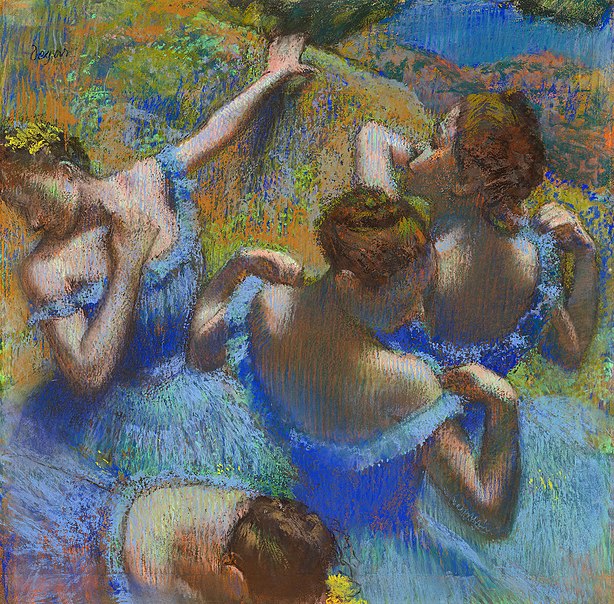
File:Edgar Germain Hilaire Degas 076.jpg
Culturebaby's favourite: Edgar Degas' Blue Dancers from Wiki Commons


4. Next, the Mini Masters series from Merberg and Bober is a set of beautifully-made little glossy board books. Again these are published by Chronicle Books and feature the work of one artist - taking the child on a lyrical journey through some of their well-known art. Dancing with Degas  is the favourite with our miniature ballerinas - it uses the paintings of Degas to walk us through a ballerina's day; from preparation and rehearsal to performance and rest. There are mixed reviews of the text of this book (some think the language could be better), but I think the book (and series) are a great idea and the text does the job - the rhymes help the book flow and remind Culturebaby of the paintings she likes. I would really recommend them. We used the book to talk about which scene we'd like to jump into, we talked about what the ballerinas were doing and what they were wearing, and which instruments are depicted . Culturebaby had clear favourites, which she flicked through and found for herself again and again.

5. Readers will already know we are a fan of Miffy at the Gallery and Miffy the Artist. These brilliant little classic story books by the iconic illustrator Dick Bruna, who took inspiration from Matisse's bold use of colour in art, feature a visit by the endearing little bunny with her parents to a modern art gallery and serve as a brilliant introduction for any toddler doing the same. They cleverly introduce easier concepts of both figurative art and sculpture, but also surrealism, collage and use of mobiles. They even contain a bunny ears version of Matisse's La Gerbe. Miffy becomes an amateur art appreciator and critic, and in turn is inspired to go home and try painting for herself in Miffy the Artist, a clever follow-up book produced by Tate and Dick Bruna that majors on the inspiration art galleries can give to a toddler for their own creativity.

We were therefore delighted to see that in 2015 Tate produced a new, and slightly simpler, Lift-the-Flap board-book version of Miffy the Artist. The very young progress from black and white to cloth and then feely books as their vision and dexterity develops. Around nine months, I found that the girls started to really enjoy the cause and effect and surprise elements of lift-the-flap books. Culturetot still enjoys these, which are the pre-cursors to the brilliant and much more complex Usborne Look inside books, which appeal to much older children with the same basic concept. This version of Miffy the Artist is an accessible introduction to gallery going, and the important creative process of inspiration and consequent production. "At the end of the day Miffy knew she was a real artist". A message for all our little paintbrush-wielders to hear.


6. Finally, I'd like to recommend a new series of First Concepts with Fine Artists from the brilliant publisher of art books Phaidon. I'm really excited about these clever, stunningly produced and well thought-out titles. Each glossy board book takes a learning theme (colour, shape etc...) and in such simple terms explores how these feature in a range of the artist's work.

In April we received the first in this series to test - Blue and Other Colours with Henri Matisse. Two year old Culturetot and I have loved working through the book, spotting and naming the colours used, reading the text, answering questions posed and talking about our favourite works amongst the many (over 25) featured. The book focuses on Matisse's cut-outs - produced during his 17 twilight years when he was recovering from cancer and was often too sick to hold a paintbrush. Matisse had his assistants paint large sheets of paper in a wide range of colours, he cut them into shapes and then had them arrange these on his studio walls. He cut and arranged and re-worked these until he had his perfect composition - surrounding himself with a bright paper "garden" of his own creation. For toddlers, as we experienced in the Tate Modern's brilliant retrospective, this work is bold, dynamic and memorable; a catalyst for creativity. Youngsters, in particular those who still struggle to etch complex images and get frustrated that their drawings don't yet look on paper as they intend, can perhaps see in the aged Matisse a kindred spirit who distilled shapes down to their simplest form to create something wonderful. They too can use ready-made cut-outs to create an exciting artistic composition or, for the slightly older tots, take a pair of scissors and use them to 'draw' simple shapes.This book works well in combination with the Mini Masters A Magical Day with Matisse, which focusses on his earlier period.

Next to be published on the 4th October is Squares and Other Shapes with Josef Albers. We've had a sneak preview and think it is brilliant. Albers was born in Germany in 1888 and was a leading pioneer of 20th Century Modernism and his work Interaction of Colour is still used by students today to learn about colour in art and in nature. I don't know his work well so exploring over 30 of his works has been a delight for me too. His series of works entitled Homage to the Square are his best known and several are featured in the book, alongside many others. We find towers of wobbly rectangles, bouncing circles, napping oblongs, sharp triangles and circles hiding in squares. Albers liked the way that colours looked (and seemingly changed) when juxtaposed with other colours. Some colours made his squares within squares look as if they were 'glowing'; others recede or pop-out of the picture. This is a fabulous book for learning shapes, but is also brilliant on many levels - for discussing colour and form, size and mood, perception, and exploring iconic artists in a fun way with the youngest appreciators. I can't wait to see who is up next...


“Art is as natural as sunshine and as vital as nourishment.” 

MaryAnn F. Kohl

“It is the supreme art of the teacher to awaken joy in creative expression and knowledge.” 

Albert Einstein


Disclaimer: We received the two titles from Phaidon, Miffy the Artist and Art for Baby Colour for review purposes from the publishers (with thanks). All other titles we bought. As always, all views are very much my own.

Thursday, 24 March 2016

Calder for Kids

http://kids1.tate.org.uk/blog/wp-content/uploads/2015/11/T00541_10.jpg
Alexander Calder,
Antennae with Red and Blue Dots, c1953
Aluminium and steel wire © ARS, NY and DACS, London 2002

Since the Culturebabies have been around there's been a number of wonderfully bright, enagaging and immersive exhibitions at the Tate Modern that have been perfect to excite little minds and senses. This year's Spring retrospective is another goodie: showcasing the innovative art of Alexander Calder. He is most famous for his invention of that staple item of the nursery: the mobile (scuplture in motion) and so it is a particularly appropriate exhibition for young families.

I can imagine as babies that the girls would have loved the simple, giant, bright and floating works - so its an recommended trip for parents with babes in arms. This time we had a barrier-defying toddler and four year old Culturebaby and it was perhaps fortunate that the former passed out in the first room and I was able to focus on one child. The excellent exhibition begins with Calder's earlier work with wire (we even found a Gorgon!) and toys with moving parts. An engineer by training, Calder loved to work with all sorts of random objects - creating beauty from rubbish. His 1927 'Dog', using only a piece of wood, clothespeg and wire could not be anything other than a canine. There is genius in his work's simplicity, and it is therefore so accessible to children who could easily emulate these creations themselves. The sadness, of course, with some of these originally moving works is that they can no longer be operational and sit glumly, robbed by time and creaky parts, of their true glory. For a child they are consequently rather easy to miss. Less so, however, are his circus performers. Due to a couple of brilliant books we read on Calder before going to the exhibition, Culturebaby noticed these immediately. Calder loved the Circus so much that he created his own company from cork, wire, cloth, leather and other parts, bringing them to life with music and moving parts. We went on to create our own junk-modelled version at home later.


There is then a series of, frankly more exciting, rooms with some stabiles and a whole host of enormous mobiles. The largest room is the most awe-inspiring. Sensitive enough at times to respond to being blown, these kinetic sculptures quiver and spin in response to the movement in the rooms. Culturebaby, unpromped, lay and looked up at a number of them from below. Passers-by clearly looked on, wishing they were quite so brave as a child! Needing little explanation but prompting much observation and discussion about the materials used, the colours and why some moved more than others, this exhibition needed no additional activity than a game of spot the picture in the mini exhibition guide throughout the rooms and some sculpting with a chain (see Geis' book below).


However, when we went for coffee afterwards, Culturebaby immediately got out her (gorgeous and inventive) Meet the Artist: Alexander Calder by Patricia Geis, and began to set up the pop-up circus contained therein. This is one of the most interactive and clever art books I've seen and I highly recommend. It contains pop-ups, press-out play scenes, and even a chain to sculpt into profiles. It also covers some great facts about the artist's life. His friends called him Sandy and his favourite colour was red. He worked with it, and he wore it. He created toys, designed jewellery, painted and even decorated cars and planes. We can see some of his moving sculptures from the mere age of 11 and by the time he was in his 40s, he created stabile structures so large people could walk under them. His dynamic works brought to life the Parisisan avant-garde's fascination with movement. Calder said that: "When everything goes right, a mobile is a piece of poetry that dances with the joy of life and surprise." So very true. One of my ensuring memories of a child was of a mobile my Dad created for my brother from Christmas baubles. We did the same for Culturebaby.


At home we followed on with some themed creative activities and, happily, this time I was able to be deeply lazy and use the inventiveness of others as insipration. On several occasions we made Calder-inspired sculptures using a gorgeous set of Shapescapes ("Sculpture in a Box") sent to us from the Tate shop to try out. As a child (and adult) I've always loved Galt's Octons, a great construction tool made up of various coloured 8 sided shapes. Shapescapes uses a similar principle - colourful pieces slotting together to create wonderful designs, but the range of pieces is fantastic and irregular - resulting in the youngest child being able to design their own easy-to-make colourful sculptures. This is the sort of open-ended and beautifully-made resource that stimulates truly independent and creative play and we will treasure and no doubt use it in many ways as the children grow. I've rarely seen Culturebaby so creative and imaginative as I did recently when she created an entire Sculpture Park for her miniature dolls to explore, climb, ride and discuss.


Then finally, using Ed Cheverton's clever book Meet the Circus, we set about our own junk-modeling and made our own troupe of Calder-inspired performers. This children's book, inspired by but not majoring on, Calder's work invites the reader to take inspiration from the ideas in the book to create extra characters, use their imagination to make sculptures with moving parts and set up a circus ring in their own living room with their creations. Aided by a vintage Duplo audience and a stash of arty and crafty bits, toilet rolls, clips, balls and even curtain rings, we constructed four rather cute characters and helped them perform. The circus even had to do a run of a few days. Success indeed!


 I'd like to do one further follow-on activity in the coming weeks - actually create some mobiles with the girls with wire and sturdy cut out card. Here's an example of the sort of thing from Deceptively Educational. Given Culture-Grandad's excellent track record with making some (truly stunning) ones for us as children, I figure this might well call for a spot of targeted delegation...

Alexander Calder is open at the Tate Modern until 3rd April, and would be an excellent family Easter outing. Further information is available here. We were very grateful to receive a review copy of Meet the Circus and a set of Shapescapes from the Tate Shop (available here). We purchased a set of postcards for I-Spy and our own copy of Alexander Calder by Patricia Geis from Tate's shop. All come highly recommended as truly creativity-inspiring resources. Here is also a worksheet produced by Tate Create to make your own circus.
Related Posts Plugin for WordPress, Blogger...