Showing posts with label baby books. Show all posts

Saturday, 10 September 2016

Art Baby: Best Art Board Books for the Very Young


In the last couple of years I've had numerous requests for recommendations for the best, most accessible and age appropriate art books for the very young. I thought I'd take the opportunity of celebrating the launch of a very welcome addition to this well thumbed pile, to share a round up of the most effective art board books we have discovered.

1. First stop, a brilliant book I bought at the Tate Modern called Art For Baby. I have become rather an evangelist for it (it's a much purchased new baby gift from us) as it is both beautiful and engaging. Containing monochrome images by famous artists, such as Ohana (1999) by Takashi Murakami (which was a definite favourite for both girls), this clever introduction to art (complete with additional wall frieze) gripped Culturebaby right from the start. In the first weeks of life babies see differently to us and are most attracted to people's faces, bold patterns (especially black and white) and contrasts between light and dark (that's why babies stare at windows). I've written about this further in this post. As Montessori from the Start notes: "The baby gradually develops focus on a moving object, tracking of an object, and perception of colour and depth." Step in the next two beautiful books in the series Art for Baby Faces (same format as the first title but with twelve striking and varied faces from contemporary and modern artists from Ofili to Picasso); and Art for Baby Colour. The latter is still a favourite in our household. The box contains four mini concertina galleries in each of red, blue, yellow and green and featuring 44 works by leading modern and contemporary artists. Whilst these little books are perfect for small hands, they have really come into their own in imaginative play. They can be easily set up into a whole art gallery for small characters and are regularly used by both girls.


2. The second set I bought were the beautiful little titles from Chronicle Books (USA) and Susan Goldman Rubin: Andy Warhol's Colors, Matisse Dance for Joy and Magritte's Imagination. The first two in particular have been extremely successful with the girls. We discovered Andy Warhol's Colours first online. This beautifully designed board book introduces colours through Warhol's animal art (for further suggestions on great animal themed art books see HERE). It is a perfect size for little fingers, feels shiny and beautiful to touch and has an engaging rhyme throughout. It was one of Culturebaby's first favourite books and came with us everywhere. The minute your baby is out of black and white books, I'd put this top of your to-buy list. We even included it, complete with colour activity, as a summer book exchange  (see the follow-on activity HERE).


The Matisse Dance for Joy is a perfect little introduction to the link between joy, art and movement. It's not only a book to read. It's a book to dance! This inspired little boardbook was a favourite for quite a while, particularly given Culturebaby's penchant for ballet. It takes a number of Matisse's cut-outs which involve dance and movement, and provides a simple text which directs the reader to recreate the movements and join in. It brings the images alive and gives a sense of the dynamism and energy of Henri's works, which were very much inspired by his love for music (he was a keen violinist). We took the book to the blockbuster Matisse show at Tate Modern a couple of years ago and it served both as a guide-book for the children to find favourite images in the galleries and helped to show this connection between movement and image in many of the works before them.


 3. At a similar time I also bought another set of titles from American publisher Sterling and authors Julie Appel and Amy Guglielmo. I've never seen anything quite like these touchy feely art books, which invite the child to explore real art in a tactile way. Although the text of these books leaves a little to be desired, the concept is brilliant. We used the pop art edition Pop Warhol's Top as part of a project on Andy Warhol (see HERE). All the children loved popping the top of the Campbell's Soup can, fluttering Marilyn's eyelashes, pulling the lettuce out of Oldenburg's Two Cheeseburgers and, best of all, feeling the sticky sauce on Lichtenstein's Mustard on White.

We also particularly love Tickle Tut's Toes, included HERE in a post on Egypt for tots. 

Though this series is aimed at ages 4+ because it has parts that can unravel, I'd really disagree with this and say the best audience is a supervised 1-2 year old. Like the engaging 'That's not my...' series, the appeal of these books are the touchy-feely elements. Little paws can explore mummy wrappings, sandy sarcophagi and corrugated pyramids, pick Monet's waterlilies and make Van Gogh's bed. They contain photographs, original artworks and a simple rhyming text. There's also a section at the back of each volume with context and information for each image. 
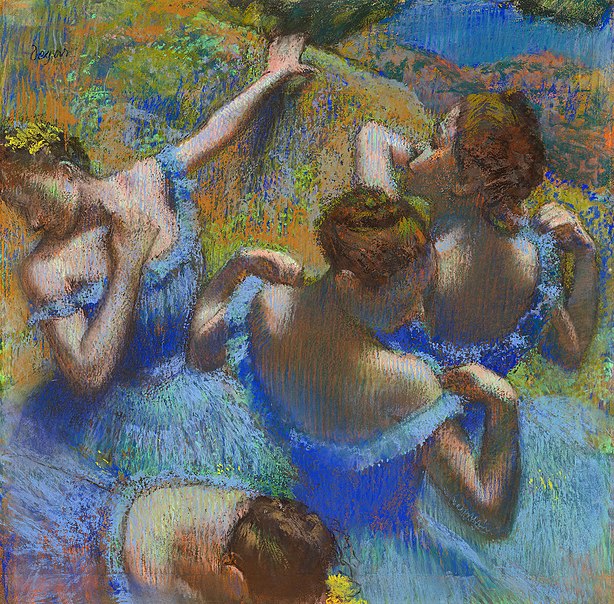
File:Edgar Germain Hilaire Degas 076.jpg
Culturebaby's favourite: Edgar Degas' Blue Dancers from Wiki Commons


4. Next, the Mini Masters series from Merberg and Bober is a set of beautifully-made little glossy board books. Again these are published by Chronicle Books and feature the work of one artist - taking the child on a lyrical journey through some of their well-known art. Dancing with Degas  is the favourite with our miniature ballerinas - it uses the paintings of Degas to walk us through a ballerina's day; from preparation and rehearsal to performance and rest. There are mixed reviews of the text of this book (some think the language could be better), but I think the book (and series) are a great idea and the text does the job - the rhymes help the book flow and remind Culturebaby of the paintings she likes. I would really recommend them. We used the book to talk about which scene we'd like to jump into, we talked about what the ballerinas were doing and what they were wearing, and which instruments are depicted . Culturebaby had clear favourites, which she flicked through and found for herself again and again.

5. Readers will already know we are a fan of Miffy at the Gallery and Miffy the Artist. These brilliant little classic story books by the iconic illustrator Dick Bruna, who took inspiration from Matisse's bold use of colour in art, feature a visit by the endearing little bunny with her parents to a modern art gallery and serve as a brilliant introduction for any toddler doing the same. They cleverly introduce easier concepts of both figurative art and sculpture, but also surrealism, collage and use of mobiles. They even contain a bunny ears version of Matisse's La Gerbe. Miffy becomes an amateur art appreciator and critic, and in turn is inspired to go home and try painting for herself in Miffy the Artist, a clever follow-up book produced by Tate and Dick Bruna that majors on the inspiration art galleries can give to a toddler for their own creativity.

We were therefore delighted to see that in 2015 Tate produced a new, and slightly simpler, Lift-the-Flap board-book version of Miffy the Artist. The very young progress from black and white to cloth and then feely books as their vision and dexterity develops. Around nine months, I found that the girls started to really enjoy the cause and effect and surprise elements of lift-the-flap books. Culturetot still enjoys these, which are the pre-cursors to the brilliant and much more complex Usborne Look inside books, which appeal to much older children with the same basic concept. This version of Miffy the Artist is an accessible introduction to gallery going, and the important creative process of inspiration and consequent production. "At the end of the day Miffy knew she was a real artist". A message for all our little paintbrush-wielders to hear.


6. Finally, I'd like to recommend a new series of First Concepts with Fine Artists from the brilliant publisher of art books Phaidon. I'm really excited about these clever, stunningly produced and well thought-out titles. Each glossy board book takes a learning theme (colour, shape etc...) and in such simple terms explores how these feature in a range of the artist's work.

In April we received the first in this series to test - Blue and Other Colours with Henri Matisse. Two year old Culturetot and I have loved working through the book, spotting and naming the colours used, reading the text, answering questions posed and talking about our favourite works amongst the many (over 25) featured. The book focuses on Matisse's cut-outs - produced during his 17 twilight years when he was recovering from cancer and was often too sick to hold a paintbrush. Matisse had his assistants paint large sheets of paper in a wide range of colours, he cut them into shapes and then had them arrange these on his studio walls. He cut and arranged and re-worked these until he had his perfect composition - surrounding himself with a bright paper "garden" of his own creation. For toddlers, as we experienced in the Tate Modern's brilliant retrospective, this work is bold, dynamic and memorable; a catalyst for creativity. Youngsters, in particular those who still struggle to etch complex images and get frustrated that their drawings don't yet look on paper as they intend, can perhaps see in the aged Matisse a kindred spirit who distilled shapes down to their simplest form to create something wonderful. They too can use ready-made cut-outs to create an exciting artistic composition or, for the slightly older tots, take a pair of scissors and use them to 'draw' simple shapes.This book works well in combination with the Mini Masters A Magical Day with Matisse, which focusses on his earlier period.

Next to be published on the 4th October is Squares and Other Shapes with Josef Albers. We've had a sneak preview and think it is brilliant. Albers was born in Germany in 1888 and was a leading pioneer of 20th Century Modernism and his work Interaction of Colour is still used by students today to learn about colour in art and in nature. I don't know his work well so exploring over 30 of his works has been a delight for me too. His series of works entitled Homage to the Square are his best known and several are featured in the book, alongside many others. We find towers of wobbly rectangles, bouncing circles, napping oblongs, sharp triangles and circles hiding in squares. Albers liked the way that colours looked (and seemingly changed) when juxtaposed with other colours. Some colours made his squares within squares look as if they were 'glowing'; others recede or pop-out of the picture. This is a fabulous book for learning shapes, but is also brilliant on many levels - for discussing colour and form, size and mood, perception, and exploring iconic artists in a fun way with the youngest appreciators. I can't wait to see who is up next...


“Art is as natural as sunshine and as vital as nourishment.” 

MaryAnn F. Kohl

“It is the supreme art of the teacher to awaken joy in creative expression and knowledge.” 

Albert Einstein


Disclaimer: We received the two titles from Phaidon, Miffy the Artist and Art for Baby Colour for review purposes from the publishers (with thanks). All other titles we bought. As always, all views are very much my own.

Sunday, 24 May 2015

Baby Book Club: Around the World


On a sunny day a few weeks ago, when we had a group of Culturebaby's older friends visiting, I finally got round to setting up an outdoor tactile geography activity for them to explore together. I've been planning this one ever since I found a lovely laminated cloth map amongst the rolls of fabric in a haberdasher's shop and discovered that Safari Toobs do a couple of brilliant sets of landmark models. It was really satisfying to watch the children work together to discover where the buildings and historic landmarks should be situated and then cluster them together in the correct locations on the map. We even cracked open the fossils and animals to add them into the mix and played games; encouraging the children to stand in warm spots, cold climates and locate oceans and mountains. 
Culturebaby is beginning to understand the concept of a map and has started to sketch out mazes and routes in a spatial way. This sort of activity seemed to work well for her to explore basic geographical ideas. She clearly enjoyed it enough that when another friend visited later in the day, she got the activity back out for him to see too. She's also a big fan of miniature world play and these models have also really helped her to become familiar with the names and construction of iconic buildings and we also used the map to talk about family members who are currently elsewhere in the world.
Since I've had children, I've also become more aware of not only the authors and illustrators but also the publishers of the books we read and love. Finding a great new publisher is like discovering the taste for a new cuisine which - Boom! - becomes an instant favourite and you want to savour more on the menu. We've recently been treated to a fabulous pair: Gecko Press and Minedition - each of which specialise in bringing books from around the world, published in other languages and countries, to an English speaking audience in the UK. It feels like such a treat to be able to experience literature that children elsewhere are growing up with daily, and being privy to the iconic images of their childhoods - from Switzerland and Italy, to New Zealand and Hong Kong - that otherwise we might never have the chance to do. Ultimately I hope to use these (already much thumbed) titles to talk about their places of origin too.

Culturetot, as any followers of our #5litaday bedtime selections will know, is a very big fan of her pair of board books from Minedition: Squares by Japanese author and illustrator Yusuke Yonezu and Peekaboo by Italian artist Giuliano Ferri. Squares is a stunningly crafted die-cut book in bold colours. It introduces the concept of shape and explores squares and rectangles in everyday life through surprise transformations of a simple form to an object on every page. Four squares become a window, two rectangles become candles... or pencils. It's a beautiful design. The sort of thing you'd find in the Tate bookshop.

Likewise, Ferri's Peekaboo is an exquisitely illustrated and predominantly wordless board book for the youngest child. Culturetot loves the game of peekaboo and was delighted to discover a book with a whole host of cheeky little animals, eyes covered ready to play her favoured game. With flaps as paws, used to uncover faces throughout and a surprise mirror at the coda, this book has been selected most days and it certainly appears to have a good deal of mileage left. It is also a great book for Culturebaby to 'read' to her sister. I wasn't surprised to discover that author Ferri works with young people with disabilities, using animation and comic theatre as therapy.

Another original title which arrived this week, and which both girls have enjoyed in equal measure, is the quirky Help! The Wolf is Coming! from French pair Ramadier and Bourgeau. Culturebaby adores anything smacking of the fairytale; she loves the simple tales of Red Riding Hood and chums and she relishes any opportunity to be scared by a sly old fox or a hungry wolf - so long as they are firmly put in their place by the end. This interesting title is an interactive book in which a wolf is in hot pursuit and the reader needs to follow the instructions (tip the book, shake, quick turn the page...) to lose the sinister little chap. Combining play and the joint pleasure of enjoying a book with others, this title has certainly landed in the 'again, again!' category for both girls.

Finally, two titles for slightly older readers. Firstly brand new title The Paradise Bird.  From Swiss author and illustrator Marcus Pfister, comes a sweet story celebrating the joy in life and the delight that can come when we open our minds to a colourful influence from outside our own experience. The ravens are bored. Not much happens and they struggle to feel motivated. Then into their monochrome world crashes a comedian; a technicolour paradise bird, who makes them laugh, dance, sing and embrace their own croaky language. It's rather a heartwarming idea, and a useful lesson in being open minded and learning from those who may seem different to us.

Then from Austrian author Heinz Janisch is a really unusual offering. Janisch has been awarded, amongst others, the Austrian State Prize for Poetry, and here he teams up with celebrated German illustrator Wolf Erlbruch to produce a volume of 21 (extremely) short stories The King and the Sea. Culturebaby and I read it together and she certainly enjoyed some of the extracts, but I can see why this picture book is aimed at 8+. Its messages are deep and profound. It could easily benefit an adult audience just as much as the older child. In each tiny tale, the king attempts to rule over an element of nature and is unable to overcome each with their powerful diversity. The rain continues to fall, the clouds to move, and the sea fails to heed the orders of a Canute-like crown-bearing human. This little king sees his limits and learns from nature - from the trees to the sky. He understands that the trumpet must be used not ordered to deliver its sound and the pencil must be handled to produce great value. It's an original book that is rather reminiscent of The Little Prince. One to ponder and re-read.

Disclaimer: The books mentioned and the Safari Toobs were sent to us, on request, for review purposes. The map was our own purchase. Similar material can be found in fabric shops and market stalls. All the titles are available for purchase in the UK.

Monday, 9 February 2015

Food for the Soul: Our 5 a Day Literary Diet

A new year, new resolutions, and my biggest aim for Culturetot is to read more with her alone. It's trickier with a second child to find quality time to sit down peacefully together, have a snuggle, and wade through baskets of books like Culturebaby and I had the luxury of doing. Establishing a routine around storytime before bed has really helped. At 14 months Culturetot expects it, understands what I'm saying when I ask her to choose a story, and has begun to say 'there' and point at her books when a certain title she requires is out of reach. I've noticed that this has a knock-on effect on her general awareness of reading material and we've begun to retreat to her cosy little room, sit on her rug and steal a story moment or two in the quieter parts of our days together.

I no longer set myself up to fail by resolving to change the world fifteen tasks at a time every January. This year I only had a couple of resolutions, and one was to ensure that we read at least five books a day with each of the girls. As Adrienne Rich noted so sagely “You must write, and read, as if your life depended on it”. Culturebaby at three is just embarking on her reading journey; stringing together letter sounds, recognising the odd word, retiring to her bed to peruse a pile of Ladybird fairytales. I'm so excited for her. Daily she is discovering new worlds for the first time. She's already besotted with the technicolour wonder of Oz and entranced by the magic of Potter's imagination, but somewhere just out of sight wait Narnia, Middle Earth, Wonderland, Brisingamen; Aslan, Gandalf, five friends in search of mystery, friendly giants, a box of delights... For me, their literary diet is just as crucial as their physical one, with words like vitamins stimulating the brain and bringing with their consumption a fullness of life. For Culturetot this is all just beginning. As she lifts flaps in hot pursuit of Spot, presses buttons to hear lions roar and paws at pages embedded with varied textures, the path ahead seems long but laden with treasures.

I've recently been thoroughly inspired by the stunning writing of the late Kate Gross. Her blog and book Late Fragments, which chart her courageous and dignified battle with terminal cancer, are far from gloomy. Rather they speak into the heart of things: dwelling on what is ultimately important and the beauty of coming full circle to that which first inspired us as children. When all began to fall away; her glittering career, her health and her dreams of the future, Kate writes that she returned to the root of all meaning for her in her final months - her family, her friends, her children and her books. Her love of words, returning to the landscapes of her inner self and regaining her 'enduring melody' through her first love - her ten year old's clarity that literature made her tick - brought her solace and peace. And she has left her sons a treasure map to what truly defined her - her book, and also a bookcase, banded in age brackets, of the works that have been important to her throughout her life. This 'library for life', which she was encouraged by her university Dons to build sits true with me. I'm always more content and more alive when I'm surrounded with my shelves of books. For me they reach across wall-space like a painting depicting my history; a catalogue of my innermost desires and inspiration and where I can return to unlock a host of memories within each binding. Even a glance at their spines has the capacity to ground me and remind me of who I am, and importantly where I ultimately want to be. A Kindle simply won't do. As Kate notes: "Reading is an experience by which we connect ourselves to what we are, to this magnificent, awful life, in which the same grooves are being scored over and over again in different tongues. It is about how you experience humanity." It is one of the most important doors I will ever unlock for my little ladies.

I've been thinking about my tips for instilling a love of books in our little ones right from the start, and without a doubt, for both girls, but Culturetot in particular, the means by which their stories are offered and displayed is extremely significant. For Culturebaby we had a couple of bigger bookshelves, which, if left to their own devices, were either unceremoniously emptied or ignored; and then a scattering of baskets containing a smaller selection of books throughout the house. These generally get better use as they are accessible and good for browsing. For a while, however, I'd been drooling over the ingenius kids' bookcases created by Tidy Books owned by a number of my friends. The concept is simple but brilliant. Toddlers cannot read; they struggle with large bookshelves with books stacked where only the spine can be seen. Aesthetics matter. How the reading material is offered affects young children's choice, suggestion can help their selection, and they most certainly judge a book by its cover. Tidy Book cases are shallow and unlike normal book shelves display a selection of up to 90 books with their front covers facing outwards. A few months ago we were sent one to review for the nursery and I couldn't praise its concept and design more highly. Since Culturetot and I started a quiet reading routine, cuddled on a rug in front of her Tidy Books case - which is a beautiful and central fixture in her bedroom - I have seen her interest in books truly begin. Now when I ask her where her stories are, she points and says 'there'. She toddles over, and selects one after another, browsing with her eyes and chubby little toddler paws. Inevitably such interest and means of display ensures I no longer leave board books festering forgotten in the bottom of a basket. This bookcase requires that I keep an appropriate selection in steady circulation and I can respond better to my baby's interest as she displays clear preferences for certain types of book, or returns to the same cover again and again.

Some of Culturetot's bedtime selection this evening
Recently I read an interesting discussion in a librarian's magazine about the sorts of books that were borrowed most frequently. Suggested reads in forward facing display shelves, books at hand and eye height in the most accessible shelves seemed to play a large influence in patterns. I'd also say that for toddlers the front cover design is rather crucial - something the Tidy Books philosophy recognises. I took the opportunity to ask a few of our favourite children's authors and publishers what they thought about this and they offered some interesting insights. Tamsyn Murray talked about the important balance of capturing a flavour of the book in an eye catching way and doing something a little different; whilst Birgitta Sif shared that for herself as a child it was the intriguing details of front covers balanced with good graphics that drew her to a title. James Mayhew talked about the attraction for young children of specific subject matter, and noted that he prefers the newer unfussy Katie covers with their clear character and theme. Likewise others pointed out that anything with a duck or animal was guaranteed to be a winner with their little ones. The wonderful publisher Child's Play also shared a helpful insight into their front cover design process: "...we always make the covers of our baby books fun and dynamic. We have found that simple designs and contrasting elements are popular. The emotion of the cover is another important factor that mustn’t be overlooked. It’s crucial that the design on the cover accurately conveys what the book is about to the reader, before they’ve even read the title.” Or of course if they are too dinky to do so themselves...

Culturebaby's bedtime selection today
Through observation of Culturetot's preferences as she's been browsing her favourite lit, I'd also recommend that parents have available on their bookshelves for this age a selection of the following: touchy-feely books with textures; books with flaps to open; noisy titles with a range of buttons; books containing photographs of other children and images of animals; high contrasts and bold art; titles containing repetition, rhyming or musical text; books with elements to manipulate (such as parts to slide and move); word books containing photographs of items a baby needs to learn; and tiny books for little hands to handle with ease. Combined with an attractive and accessible means of display there is little more my little Culturetot needs in her nursery. Her bookcase has been the best gift we've given her to date.

Disclaimer: Our TidyBooks bookcase was sent to us by this fab eco friendly and responsible business, to test in advance of an honest review. We love it and as always all views are very much my own.
If you fancy following some of our 5 a day selections, like our page on Facebook, where we post more regular updates.
Related Posts Plugin for WordPress, Blogger...