Saturday, 10 September 2016

Art Baby: Best Art Board Books for the Very Young


In the last couple of years I've had numerous requests for recommendations for the best, most accessible and age appropriate art books for the very young. I thought I'd take the opportunity of celebrating the launch of a very welcome addition to this well thumbed pile, to share a round up of the most effective art board books we have discovered.

1. First stop, a brilliant book I bought at the Tate Modern called Art For Baby. I have become rather an evangelist for it (it's a much purchased new baby gift from us) as it is both beautiful and engaging. Containing monochrome images by famous artists, such as Ohana (1999) by Takashi Murakami (which was a definite favourite for both girls), this clever introduction to art (complete with additional wall frieze) gripped Culturebaby right from the start. In the first weeks of life babies see differently to us and are most attracted to people's faces, bold patterns (especially black and white) and contrasts between light and dark (that's why babies stare at windows). I've written about this further in this post. As Montessori from the Start notes: "The baby gradually develops focus on a moving object, tracking of an object, and perception of colour and depth." Step in the next two beautiful books in the series Art for Baby Faces (same format as the first title but with twelve striking and varied faces from contemporary and modern artists from Ofili to Picasso); and Art for Baby Colour. The latter is still a favourite in our household. The box contains four mini concertina galleries in each of red, blue, yellow and green and featuring 44 works by leading modern and contemporary artists. Whilst these little books are perfect for small hands, they have really come into their own in imaginative play. They can be easily set up into a whole art gallery for small characters and are regularly used by both girls.


2. The second set I bought were the beautiful little titles from Chronicle Books (USA) and Susan Goldman Rubin: Andy Warhol's Colors, Matisse Dance for Joy and Magritte's Imagination. The first two in particular have been extremely successful with the girls. We discovered Andy Warhol's Colours first online. This beautifully designed board book introduces colours through Warhol's animal art (for further suggestions on great animal themed art books see HERE). It is a perfect size for little fingers, feels shiny and beautiful to touch and has an engaging rhyme throughout. It was one of Culturebaby's first favourite books and came with us everywhere. The minute your baby is out of black and white books, I'd put this top of your to-buy list. We even included it, complete with colour activity, as a summer book exchange  (see the follow-on activity HERE).


The Matisse Dance for Joy is a perfect little introduction to the link between joy, art and movement. It's not only a book to read. It's a book to dance! This inspired little boardbook was a favourite for quite a while, particularly given Culturebaby's penchant for ballet. It takes a number of Matisse's cut-outs which involve dance and movement, and provides a simple text which directs the reader to recreate the movements and join in. It brings the images alive and gives a sense of the dynamism and energy of Henri's works, which were very much inspired by his love for music (he was a keen violinist). We took the book to the blockbuster Matisse show at Tate Modern a couple of years ago and it served both as a guide-book for the children to find favourite images in the galleries and helped to show this connection between movement and image in many of the works before them.


 3. At a similar time I also bought another set of titles from American publisher Sterling and authors Julie Appel and Amy Guglielmo. I've never seen anything quite like these touchy feely art books, which invite the child to explore real art in a tactile way. Although the text of these books leaves a little to be desired, the concept is brilliant. We used the pop art edition Pop Warhol's Top as part of a project on Andy Warhol (see HERE). All the children loved popping the top of the Campbell's Soup can, fluttering Marilyn's eyelashes, pulling the lettuce out of Oldenburg's Two Cheeseburgers and, best of all, feeling the sticky sauce on Lichtenstein's Mustard on White.

We also particularly love Tickle Tut's Toes, included HERE in a post on Egypt for tots. 

Though this series is aimed at ages 4+ because it has parts that can unravel, I'd really disagree with this and say the best audience is a supervised 1-2 year old. Like the engaging 'That's not my...' series, the appeal of these books are the touchy-feely elements. Little paws can explore mummy wrappings, sandy sarcophagi and corrugated pyramids, pick Monet's waterlilies and make Van Gogh's bed. They contain photographs, original artworks and a simple rhyming text. There's also a section at the back of each volume with context and information for each image. 
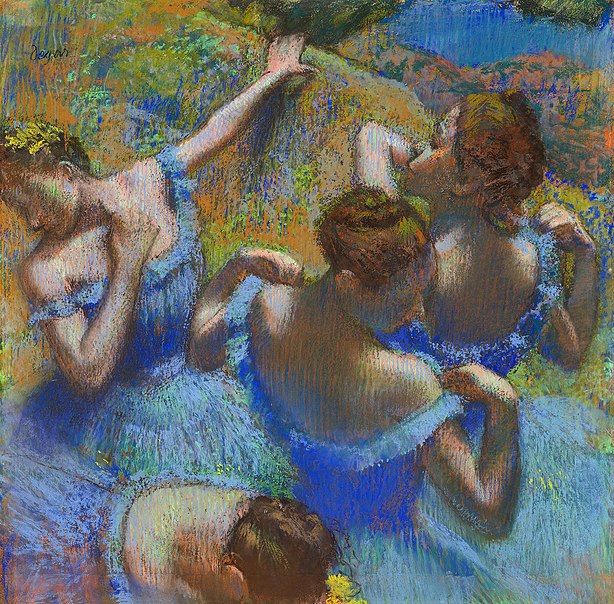
File:Edgar Germain Hilaire Degas 076.jpg
Culturebaby's favourite: Edgar Degas' Blue Dancers from Wiki Commons


4. Next, the Mini Masters series from Merberg and Bober is a set of beautifully-made little glossy board books. Again these are published by Chronicle Books and feature the work of one artist - taking the child on a lyrical journey through some of their well-known art. Dancing with Degas  is the favourite with our miniature ballerinas - it uses the paintings of Degas to walk us through a ballerina's day; from preparation and rehearsal to performance and rest. There are mixed reviews of the text of this book (some think the language could be better), but I think the book (and series) are a great idea and the text does the job - the rhymes help the book flow and remind Culturebaby of the paintings she likes. I would really recommend them. We used the book to talk about which scene we'd like to jump into, we talked about what the ballerinas were doing and what they were wearing, and which instruments are depicted . Culturebaby had clear favourites, which she flicked through and found for herself again and again.

5. Readers will already know we are a fan of Miffy at the Gallery and Miffy the Artist. These brilliant little classic story books by the iconic illustrator Dick Bruna, who took inspiration from Matisse's bold use of colour in art, feature a visit by the endearing little bunny with her parents to a modern art gallery and serve as a brilliant introduction for any toddler doing the same. They cleverly introduce easier concepts of both figurative art and sculpture, but also surrealism, collage and use of mobiles. They even contain a bunny ears version of Matisse's La Gerbe. Miffy becomes an amateur art appreciator and critic, and in turn is inspired to go home and try painting for herself in Miffy the Artist, a clever follow-up book produced by Tate and Dick Bruna that majors on the inspiration art galleries can give to a toddler for their own creativity.

We were therefore delighted to see that in 2015 Tate produced a new, and slightly simpler, Lift-the-Flap board-book version of Miffy the Artist. The very young progress from black and white to cloth and then feely books as their vision and dexterity develops. Around nine months, I found that the girls started to really enjoy the cause and effect and surprise elements of lift-the-flap books. Culturetot still enjoys these, which are the pre-cursors to the brilliant and much more complex Usborne Look inside books, which appeal to much older children with the same basic concept. This version of Miffy the Artist is an accessible introduction to gallery going, and the important creative process of inspiration and consequent production. "At the end of the day Miffy knew she was a real artist". A message for all our little paintbrush-wielders to hear.


6. Finally, I'd like to recommend a new series of First Concepts with Fine Artists from the brilliant publisher of art books Phaidon. I'm really excited about these clever, stunningly produced and well thought-out titles. Each glossy board book takes a learning theme (colour, shape etc...) and in such simple terms explores how these feature in a range of the artist's work.

In April we received the first in this series to test - Blue and Other Colours with Henri Matisse. Two year old Culturetot and I have loved working through the book, spotting and naming the colours used, reading the text, answering questions posed and talking about our favourite works amongst the many (over 25) featured. The book focuses on Matisse's cut-outs - produced during his 17 twilight years when he was recovering from cancer and was often too sick to hold a paintbrush. Matisse had his assistants paint large sheets of paper in a wide range of colours, he cut them into shapes and then had them arrange these on his studio walls. He cut and arranged and re-worked these until he had his perfect composition - surrounding himself with a bright paper "garden" of his own creation. For toddlers, as we experienced in the Tate Modern's brilliant retrospective, this work is bold, dynamic and memorable; a catalyst for creativity. Youngsters, in particular those who still struggle to etch complex images and get frustrated that their drawings don't yet look on paper as they intend, can perhaps see in the aged Matisse a kindred spirit who distilled shapes down to their simplest form to create something wonderful. They too can use ready-made cut-outs to create an exciting artistic composition or, for the slightly older tots, take a pair of scissors and use them to 'draw' simple shapes.This book works well in combination with the Mini Masters A Magical Day with Matisse, which focusses on his earlier period.

Next to be published on the 4th October is Squares and Other Shapes with Josef Albers. We've had a sneak preview and think it is brilliant. Albers was born in Germany in 1888 and was a leading pioneer of 20th Century Modernism and his work Interaction of Colour is still used by students today to learn about colour in art and in nature. I don't know his work well so exploring over 30 of his works has been a delight for me too. His series of works entitled Homage to the Square are his best known and several are featured in the book, alongside many others. We find towers of wobbly rectangles, bouncing circles, napping oblongs, sharp triangles and circles hiding in squares. Albers liked the way that colours looked (and seemingly changed) when juxtaposed with other colours. Some colours made his squares within squares look as if they were 'glowing'; others recede or pop-out of the picture. This is a fabulous book for learning shapes, but is also brilliant on many levels - for discussing colour and form, size and mood, perception, and exploring iconic artists in a fun way with the youngest appreciators. I can't wait to see who is up next...


“Art is as natural as sunshine and as vital as nourishment.” 

MaryAnn F. Kohl

“It is the supreme art of the teacher to awaken joy in creative expression and knowledge.” 

Albert Einstein


Disclaimer: We received the two titles from Phaidon, Miffy the Artist and Art for Baby Colour for review purposes from the publishers (with thanks). All other titles we bought. As always, all views are very much my own.

Wednesday, 7 September 2016

Sensational Butterflies

There is something equally soothing and awe-inspiring about the experience of being surrounded by hundreds of butterflies in technicolour flight. Adults still stand in wonder when a passing butterfly takes a fancy to their colourful attire and settles. Toddlers dance and gaze with infectious joy. In recent years we have visited a number of butterfly houses, and been treated to Damien Hirst's live butterfly artwork at the Tate Modern. It is particularly convenient to have one available at the heart of London's Museumland - hosted by the Natural History Museum - each summer. 
A week or so ago Culturetot and I popped into Sensational Butterflies on our way back from a wonderful CBeebies Prom at the Albert Hall. Sourced ethically from around the world (Africa, South America, North America and Asia) there is a wide variety of colours and shapes of butterfly and moth. As you become accustomed to the surroundings you also gradually start to spot all the eggs clustered on leaves, and the weird and wonderfully formed caterpillars munching in the vegetation. The marquee is peppered with facts (apparently some butterflies hear through their wings) and houses a room with hanging and hatching chrysalises. I spoke to a woman who had been there for hours!

A couple of years ago we grew our own butterflies, which was a really interesting experience. The process lasts around a month. In the true form of The Very Hungry Caterpillar, the little nippers, who arrive in the post, rapidly increase in size over the first week. After a few days the chubby chaps begin to move their way to the top of their habitat and (if you are lucky) before your eyes they start to hang from their ceiling and (I did not know this!) emerge from the skin of the caterpillar to form a chrysalis. After all the caterpillars are attached, you move them into a hatching net. Again, it came as a slightly unnerving surprise, that the chrysalises shook and twisted when they were disturbed.They were not hatching early as we initially thought, but do this as a defence mechanism to ward off predators. How clever. On hatching we fed the butterflies fruit and after a couple of days we set them free. One of the five had an under formed wing and couldn't fly, so we also ended up with an unexpected pet for rather longer than we anticipated...

Other than the well loved classic, The Very Hungry Caterpillar, we have a couple of other books that are particularly good to accompany a butterfly-watching occasion.

The American Museum of Natural History, which has its own summer Butterfly Vivarium, has produced in recent months some brilliantly simple and engaging board books on science for the very young. One of these is a gorgeously designed Caterpillar to Butterfly, which features real photographs, basic facts and creatively graduated flaps detailing the progress of a butterfly's life cycle. We learn that butterflies taste with their feet and a butterfly's body needs to be warm to fly, and can see the rather astounding process of transformation in a series of simple steps.

I also rather like the Life Cycles series for the slightly older reader. Containing great photographs, diagrams and facts, they certainly provide an excellent guide for a parent to talk through with a child that is full of Whys?


Disclaimer: We received a copy of Melissa Stewart's excellent Caterpillar to Butterfly for review purposes. All other costs and materials were our own. Sensational Butterflies this year is open until 11th September at the Natural History Museum, London.

Saturday, 27 August 2016

Ten Pieces II: The Proms for Kids (Or the day my daughter became a Wagnerian...)

There's nothing quite like seeing your daughter falling in love with music; magnificent, passionate music that paints pictures and pins a 4 year old to their seat, gripped and inspired, and leaves them reminiscing, singing and dancing for weeks. For me it was racing to safety behind a sofa as the stone door to the Hall of the Mountain King swung shut, beating an imagined hammer to the Anvil Chorus and dashing through the snow on a horse drawn sledge with Lt Kije to Prokoviev's Troika. For Culturebaby it has also been The Nutcracker and now the swift-winged Valkyries. I've also been immensely grateful for the BBC's fabulous series Melody, which animates a piece of music for children in each episode, and Disney's Fantasia.

Towards the end of July Culturebaby (almost five) and I headed off for a 'big girl' day to the BBC Proms 12; a fantastic celebration of a set of iconic classical pieces performed for and with school children. Building on last year's huge 10 Pieces success, this year's Ten Pieces II was aimed at early secondary school children, combining dance, animation and a plethora of musical offerings.  However it was pitched, it suited the pre-schooler just as well. We listen to a lot of classical music and attend concerts regularly but there was something completely awe inspiring about the size and scale of a full orchestra in the spectacular rotunda of the Albert Hall, and Culturebaby was completely bowled over from the moment the huge organ began with Bach's (slightly unnerving) Toccata and Fugue in D Minor.

Culturebaby has declared that she loves 'big' music. She watched open mouthed the organ thundering out its Fugue and the enormous choir of children perform the epic Day of Judgement from Verdi's Requiem. However, since the concert it is the Ride of the Valkyries that has been requested over and over again. She has re-lived the clever way in which the Proms presenters built up the arrival of the Wagnerian characters using breaking 'news' videos - explaining that there had been numerous sightings of flying creatures above london and strange occurrences of glowing rings of fire on buildings and objects that shape. Finally these warrior goddesses descended upon our own circular theatre, emerging from various locations around the audience carrying glowing fragments to form a large golden ring on the stage before us. It was very effective and clearly had a remarkable effect on her. I spotted her acting out the scene with a troupe of Barbies yesterday as she hummed the tune.

Throughout the performance we were treated to ten well chosen iconic pieces of music from Bizet to Bernstein, introduced by presenters (and even a very ambitious Joseph Hayden who considered the selection of only one piece of his work rather insufficient); but we also had the chance to experience the creative responses of a whole range of talented young people in between. Following a beautiful solo performance of Vaughan Williams' The Lark Ascending by an award winning young musician, we saw school boys from Northern Ireland acting out wartime corrsepondence with loved ones. Culturebaby was really impressed by an original composition by a sibling pair. We heard about the bravery of Shostakovich in the face of a constricting communist regime and watched dancers acting out the vicious portrait of dictator Stalin. We danced to the Mambo from Westside story and we watched several groups of brilliant young musicians - notably the stunning Animate orchestra performing quirky jazz and the Able Orchestra, which included some severely disabled members who created computer art in response to the music performed by their peers.

I couldn't have hoped for a better introduction to the Proms for Culturebaby, nor might I have expected that I would emerge with a pre-school Wagnerian. Ten Pieces aims to open up the world of classical music to a generation of children, representing a range of styles and eras, and it has certainly had success in our household. I'd highly recommend these concerts to families and very much hope there will be Ten Pieces III next year.

Programme included excerpts from:
J. S. Bach
Toccata and Fugue in D minor, BWV 565
Bernstein
Mambo (from West Side Story)
Anna Clyne
Night Ferry
Haydn
Trumpet Concerto in E flat major – 3rd movement
Gabriel Prokofiev
Concerto for Turntables and Orchestra – 5th movement
Shostakovich
Symphony No. 10 in E minor – 2nd movement
Vaughan Williams
The Lark Ascending
Verdi
Dies irae and Tuba mirum (from Requiem)
Wagner
Ride of the Valkyries (from Die Walküre)

Disclaimer: We received two tickets to the Prom for review purposes. It was genuninely magnificent and all views are my own. You can see the trailer for the Ten Pieces II shown last Christmas on the BBC here to give you a flavour of it all. There will be highlights shown on CBBC on Sunday 11th September.

Monday, 25 July 2016

Into the Night Garden...

Some things in life provide wonderful experiences because of their simple and arresting joy. In the Night Garden Live is an adorable production for the very young and rarely have I witnessed such unparalleled delight in little people as at the arrival of these household names in larger than life form before their eyes.

In The Night Garden is one of those utterly bizarre, and probably genius, Cbeebies programmes that have captured the heart of a nation. At the slightest whisper of threat to children's programming, parents declare war in defence of Upsy Daisy the pacifier and Iggle Piggle the entertainer of their miniature brood. I'm not sure a few years ago that I could have imagined I'd be writing an article about this surreal toddler wonderland, but there too leapt I into the giant showdome, pre-schoolers in tow, and found myself surrounded by the Richmond parenthood chanting along in one voice to the unintelligible but gripping choruses of Makka Pakka, Akka Wakka, Mikka Makka moo! and Igglepiggle, wiggle, niggle, woo! 
I wonder what a future anthropologist falling upon some ancient footage might deduce from such scenes: who are these furry deities depicted on materials from dining equipment to painted bedroom walls, treasured in effigy and emitting strange and otherwordly chanting? But to the 2 year old, who sees true friends and companions in these colourful puppets, the whole phenomenon makes total sense.

There are two shows available this summer, each covering a simple tale. Let's be honest these are not (for the adult observer) complex and gripping tales of adventure. In ours Makka Pakka travels around the garden, introducing a range of his buddies and washing their faces. At one point he loses a sponge. The sponge is consequently recovered. There are bubbles. There is dancing. But the joy created in this showdome is utterly infectious. It was a thoroughly happy event, with audible expressions of delight throughout from young and old alike. It isn't cheap and inevitably is rather commercialised, but it is a great child-friendly performance and good option for a first experience of theatre designed entirely for and on a perfect wavelength for the very young.

My four year old, who in hindsight didn't consider herself too mature for the whole experience, was particularly taken with the sense of scale and use of various sized puppets to bring the Night Garden alive. A larger Makka Pakka emerged alongside the Pontipines, whilst a smaller puppet was used beside the enormous Iggle Piggle. There were glorious moments when Iggle Piggle's boat appears amongst the waves, when Upsy Daisy finally danced onto stage, and when projections of stars onto the ceiling made the whole experience multi-dimensional.

As I circled my toddler's palm with my finger as the show began and witnessed her childish awe at the familiar spectacle unfolding before her, the emotion associated with the brevity of this tiring but wonderful phase rather bowled me over. I found myself wanting Oliver-like to bottle the whole experience. For In the Night Garden - for better or for worse - seems to be a right of passage for today's toddler and now, as then, I recall the immortal words of Evelyn Waugh:

"I should like to bury something precious in every place that I have been happy, so that when I'm old and ugly and miserable, I could come back and dig it up, and remember."

 In the Night Garden Live runs annually and tickets can be booked at this site. The final leg of the 2016 tour opens soon in Manchester.

We received a family ticket in exchange for an honest review of the performance. As always all views are very much my own. Photographs courtesy of In the Night Garden Live.

Wednesday, 13 July 2016

Sadlers Wells Family Day: Exquisite Snow White


Family Weekend balletLORENT Snow White 25 & 26 March © Ian WestWe love Sadlers Wells, with their creativity, brilliant performances and mission to inspire young people and involve families in their programming. Last year a friend attended their Miro-inspired Family Weekend. This year Culturebaby and I were delighted to be able to spend a big girl afternoon together at the simply exquisite production of Snow White from balletLorent and re-told by Poet Laureate Carol Ann Duffy. Whilst some productions for children are technicolor and twee, this evocative production was refreshingly un-Disney. The colours were melow and the storyline was haunting and at times dark. This ballet by the award-winning BalletLorent was not for the feint hearted. There were tears in the loos from some quarters but Culturebaby never fails to surprise me with her capacity for challenging themes and she was hugely impressed by this interpretation - closer to the Grimm than the Disney - with a mother (not stepmother) who grew jealous of her daughter and a woodcutter groom not a prince. The former was food for thought that all mothers should protect and celebrate the beauty and youth of their innocent offspring and never unwittingly fall into jealousy or a desire to live through them. The latter was thoroughly welcome - a fairy tale encouraging women not to look for the rich and vain in their future mate - but the strong, courageous and good. Carol Ann Duffy captures this angle well when she says:
"I didn't expect to fall for the story of Snow White. Like so many of the Brothers Grimm fairytales, I felt that I vaguely knew a version of the story, and was most familiar with Disney's 1937 interpretation. It was only through my research that I found out that in the first published version it was Snow White's actual mother - not her stepmother - who was so jealous of her offspring's beauty that it drove her to want to murder the daughter that she had so wished for. I was hooked; it suddenly became such an important story to tell. So many of us live with a complicated and unhappy relationship with our reflection in the mirror, and this fairytale warns us of the dangers of self-criticism, brilliantly looking at the cost of our beautifying and anti-ageing efforts."

BalletLorent's mission to create high quality dance for all ages is commendable. In this touring production, they have offered the opportunity for 12 children aged six to nine years to rehearse and perform with them. These lucky children receive professional training and an opportunity to perform as part of the troupe. We were hugely impressed by their contibution and, like many productions which feature children, to an audience aspiring to follow in their footsteps their roles offer a tangible next step for other aspiring miniature dancers. By opening up productions so effectively for families both in the audience and in the production itself, as Amy Reid, a teacher in a participating school notes: "It's great to be planting that seed now instead of later on. They are little enough for this to make a difference."


Sadlers Wells supplemented this fabulous ballet with a wider programme of creative and themed activities, available free before the production. Children were invited to explore costumes, make a magic mirror or crown, write on a wall of dreams and discover hidden leaves and objects through crayon rubbing on a giant mat. Of the many productions we have seen in recent years, this is one of those that has remained with both me and my daughter and is still talked about months on. The whole experience was welcoming and evocative. The costumes and props were simple in hue but stunning in design - Snow White's wedding dress fills the entire stage. The family weekend at Sadlers Wells comes round annually. We await their next instalment with baited breath...

"If you want your children to be intelligent, read them fairy tales. If you want them to be very intelligent, read them more fairy tales." Albert Einstein

"The fairytale is in a perpetual state of becoming and alternation. To keep to one version or one translation alone is to put a robin readbreast in a cage." Philip Pullman


Disclaimer: We received review tickets in exchange for an honest review of the production. As always, all opinions are all entirely my own. Photographs of the performance itself are courtesy of Sadlers Wells and photographer Ian West
Related Posts Plugin for WordPress, Blogger...